Come Back Tomorrow: The Unglamorous Secret to Getting Better
Come Back Tomorrow
There's a gap in the creative process that separates the people who get good from the people who give up — and almost nobody talks about it. You get inspired — something clicks, you can see what you want to make, your brain is buzzing. And then you sit down to actually make it. It turns out your brain and hands are not on the same page (yet), and reality sets in.
This gap between what your imagination can conjure and what your skills can actually deliver is the Build Your Skills phase of the creative process. Not flashy, often frustrating…so it's where a lot of people quietly pack up and go home.
But let’s look a little closer at how to bridge the gap…because the possibilities are very much in reach no matter what your baseline level of skill is.
It starts with coming back tomorrow — and the day after that — and this quiet consistency is where everything actually happens.
Your Imagination Is Running Ahead of Your Hands
Here's the thing about creative skill: there's a very low bar to entry. Toddlers finger-paint. Kids draw on walls. Anyone can pick up a brush, a lump of clay, a guitar. The starting part is beautifully accessible.
But then you get an idea. A real idea. Something specific and exciting that lives vividly in your mind. And you reach for it — and your hands don't quite know how to get there yet. So instead of pushing through, a lot of people conclude: I'm just not good at this. And they stop.
What they're actually experiencing isn't a final verdict on their talent. It's just the gap. And the only thing that closes the gap is practice — specifically, the kind where you show up, try, notice what happened, and come back to try again. And if you can tune your mindset to enjoy this exploration from a place of curiosity, that’s the magic. You can live your whole life in this place and be fully satisfied along the way, rather than waiting to be happy until you’ve finally created your crowning achievement.
The first time is…
usually NOT the charm.
My Very Humbling Week with 12 Pounds of Clay
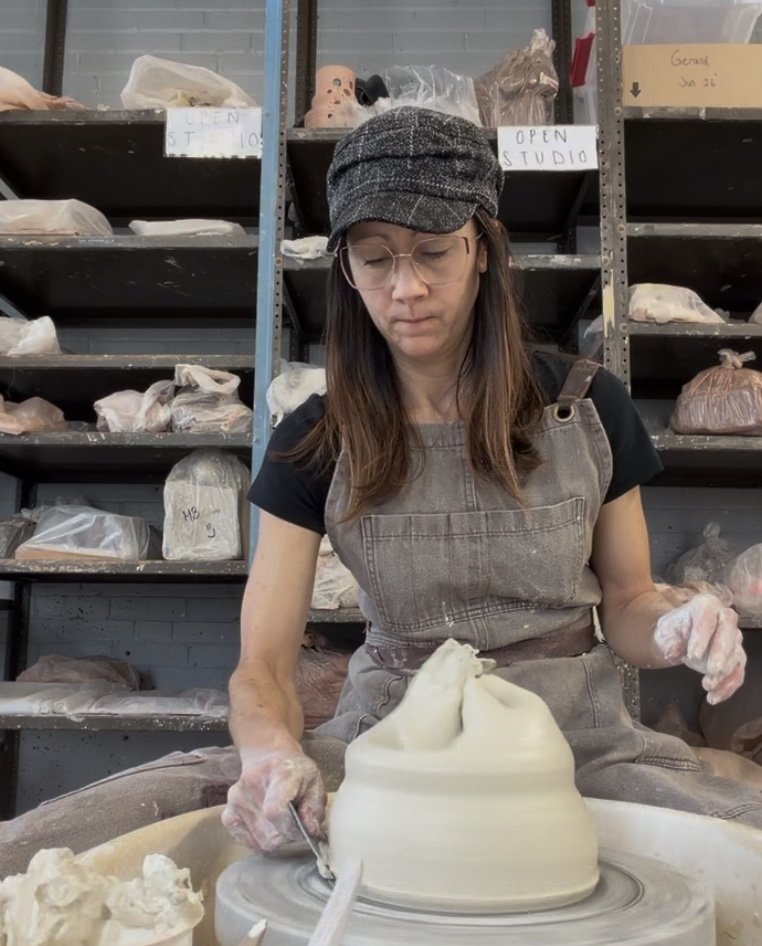
I'll give you a recent example from my own studio. I'm building a ceramic workspace in my basement, and I've been wanting to make hanging planters for it — rounded globes that taper down into a point, kind of like the ornament forms I made over the holidays. I knew the throwing method. I'd done it before! The ornaments were around half a pound of clay each.
So naturally, I decided to scale up dramatically and wedge three four-pound lumps to make actual-sized planters.
Day one: three hours of work. One piece survived, and it was... rough. Air bubbles, thin spots, a slight twist that I did not intend. I stood there looking at it like, really? I know this technique.
Except — I didn't. Not at this scale. Four pounds of clay behaves completely differently than half a pound. The physics change. The timing changes. Everything I thought I knew needed to be recalibrated.
I could have called it a day and moved on. Instead, I went back the next day. Threw two more. Faster this time. Better. Still not perfect, but good enough to hang in my studio and get the look I was after — and more importantly, I could now see a clear path forward. I took video of myself throwing, which is an incredibly useful tactic. I could watch exactly where things were going sideways. I could also see the moments where I made a good decision and the form came together, and I could feel myself filing that away for my next throwing session.
Then I talked it through with some friends at the studio — not to get advice, just to think out loud about the problem-solving. That conversation alone helped me understand what I was reaching for and how to get there.
What Your Brain Is Actually Doing
Here's the neuroscience piece: skill development is literally a process of rewiring your brain. Every repetition builds and strengthens neural pathways. The more you repeat a movement or a decision, the more automatic it becomes — which frees up your mental bandwidth for the creative choices on top of the technical ones.
That's why regular, consistent practice beats marathon sessions of forcing it. An hour three times a week will get you further than a single eight-hour day once a month. You need the repetitions, yes — but you also need the sleep, the reflection, and the return. Your brain is doing work between sessions, not just during them.
And you don't need ten thousand hours. That number gets thrown around and it makes skill-building sound like a life sentence. What you actually need is intentional repetition — showing up with a willingness to learn something specific each time. Not just going through the motions like a punishment, but asking, “What am I noticing? What do I want to try differently?”
A curious mindset, not a judgmental one. Because there’s always tomorrow.
The Only Way Out Is Through
If you're in that frustrating place where you can envision what you want to make but you can't quite execute it yet — that's not a sign you're failing. That's a sign you're in the right place. That tension between imagination and ability is exactly where growth lives.
You don't have to be great at it today. You just have to go back tomorrow. Seth Godin, author of 21 best-selling books on marketing and just how things work, said that his mindset with each book is this: Just get this one done. The next one will be better. Such a simple but powerful way to keep going.
Tomorrow, and the day after that, you'll be a little better. And eventually, what used to require all of your concentration will become second nature — and your imagination will hand you the next thing to chase after. Not to keep pushing back the finish line, but to realize there is no finish line, and living in the process is the real joy.
With Enthusiasm for Life + Art,
Heidi
Quick Win: Think of one skill you've been wanting to build. What's the smallest version of it you could practice this week — not to finish anything, just to take one intentional repetition? Write it down and put it somewhere you'll see it.
Solid Solution: James Clear's Atomic Habits is the best thing I've read on why small, consistent actions beat big dramatic efforts every single time. If you haven't read it, put it on your list.
Treat Yourself: You’ve been wanting that pottery wheel, ukulele, or watercolor set? Go for it! And make a plan for showing up regularly to see what is possible.