Why Brené Brown Writes With the TV On
How Background Sound While You Work Actually Affects Your Brain
When you picture the perfect set up for writing a book or creating a piece of art, what does it look like?
When it comes to writing, I imagine a seaside retreat where the moody, famous author is quietly scribbling away at a desk on the veranda, listening to nothing but the waves lapping the shore.
So imagine my surprise when I heard an actual best-selling author, Brené Brown, talking about the creative process of writing her books. She sympathized with the rest of us about the difficulty in just sitting down and getting your ideas onto paper. And she had a couple really interesting strategies to trick herself into finishing her writing projects.
First, she told a funny story about hiring her friends to go with her to a cabin on vacation. Her goal was to find her best most natural writing voice, so instead of typing, she spoke her ideas out loud to this group of friends, like she was telling them a story. They diligently wrote down her words, and then that became the book. Pretty great idea, but who among us can finagle taking all of our friends on vacation and taking weeks to complete a project like that?
Then, she shared another less glamorous trick, and this one actually seemed doable. In fact, it even sounded easy, and it made real, scientific sense.
Brené admitted that she often just simply writes while sitting on the couch, with familiar TV shows or movies playing in the background. Huh! The image of snacks, TV and a laptop was maybe less idyllic than the seaside writing retreat I had pictured, and yet sooo much more feasible!
I was confused though, because I've always assumed TV in the background, or even music with lyrics, would take away from your original creative ideas and distract you, causing projects to take longer and just be less pure creatively. But wait til you hear the science behind it! Your brain can actually USE that background noise.
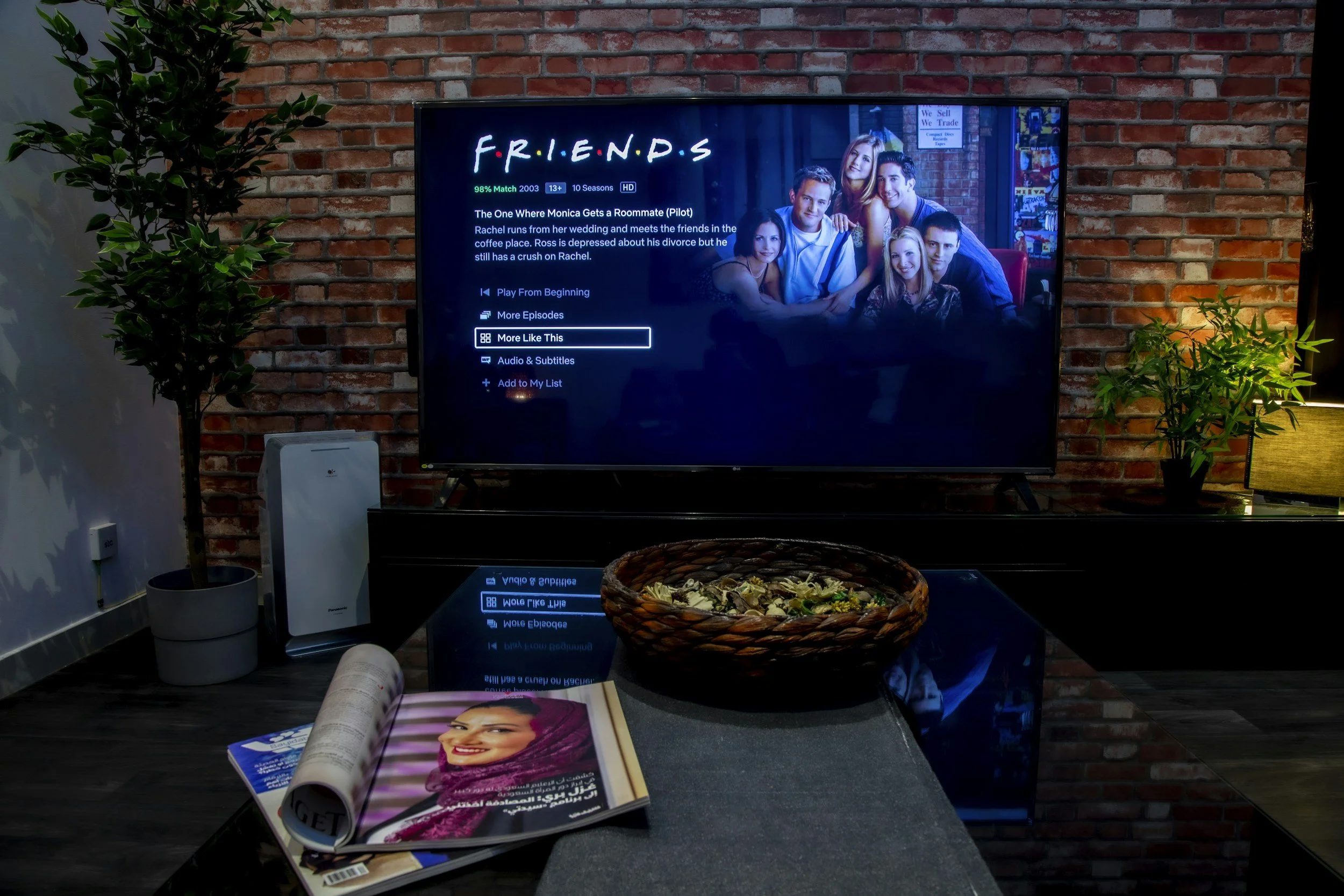
No more feeling guilty!
Let’s look at your favorite shows as the secret ingredient for your creative production.
The Science of the Comfort Rewatch
The way I understood it, the background rhythm of the familiar TV show or movie — one you've seen so often you could practically recite the whole thing — gives your brain a predictable structure. We are always tuned for novelty, with anything new or different grabbing our attention. A conversation we've never heard, a visual scene that's new to us…novelty wakes up our attention. Which can take you away from the plot of your latest novel, or cause you to lose your focus as you paint.
So when you put on that movie you've seen a thousand times, instead of being overly attuned to your neighbor starting up his leaf blower, then wondering what you might have for dinner, your brain is busy listening along to the movie, predicting what's next, and being comforted by its familiar rhythm. Your brain isn't passively receiving sound — it's constantly running ahead of the input, predicting what comes next. When the prediction holds, almost nothing gets reported up to your conscious attention. It's only when the prediction fails, when something is unexpected, that your brain flags it and pulls you toward it.
Researchers can actually see this on EEG: play someone a steady pattern of tones, slip in an odd one, and the brain throws up a distinct signal within a fraction of a second — before the person has consciously noticed anything at all. That's how automatic this is.
This is what hit home for me: Silence actually isn't the neutral we think it is. When there's nothing playing, your novelty detector has nothing to do — so every small thing that happens becomes the most interesting thing in the room. The leaf blower two doors down. A door closing upstairs. Someone's voice in the next room. In a quiet studio, those all land like notable events.
But when you put on the familiar movie, that same system finally has somewhere to be. Your ears are already engaged. Your eyes drift over now and then. The novelty detector is occupied by something it has completely solved, which means the leaf blower has competition — and it mostly loses. You're not splitting your attention and hoping there's enough to go around. You're parking the part of your brain that would otherwise go looking for trouble.
Your brain is happy just humming along to the tune and the banter, and your senses are too busy with that to get distracted by new sounds outside, or your family's conversation in the next room.
And the exciting part is that this set up leaves your creative brain free to think up new plot connections, get into your character's minds, and just focus more deeply on the creative side of your project. It's so simple! And now that I've switched my thought process by actually understanding what's happening, I can see that my brain DOES benefit from this type of background noise — I realized that I have experienced this myself in the pottery studio.
My Own Version: RENT and the Pottery Wheel
One thing I like to do when I'm throwing, especially in a busy studio, is listen to the full original Broadway cast recording of RENT. It's long, it's a predictable narrative, and it puts me in an emotionally active place following along with the familiar tunes and story line. It gives my brain structure for a throwing session — a beginning, middle, and end, and this keeps my energy flowing without burning out or wondering what's next. I stay in the moment of the characters on one hand, while my hands are free to create without over-analyzing what I'm making.
I just hadn't realized why a Broadway show seems to produce better throwing sessions than a random mix of music. But now it all makes sense! So here's your permission to settle into the couch, cue up Legally Blonde or Good Will Hunting or Office Space, and get to work!
Quick Win: Try three work sessions this week — one silent, one with something new, one with something deeply familiar. Same task each time if you can. Notice which one you came out of feeling like you'd actually gotten somewhere.
Solid Solution: Build yourself a short list of known quantities. Two or three movies, a couple of albums or cast recordings, a show you've rewatched to death. The test isn't whether you like it — it's whether it can still surprise you. If it can, it's not on the list yet. Then start matching them to the work: something with a shape and an arc for a long throwing or painting session, something looser for admin and email.
Treat Yourself: Rewatch or relisten to something on purpose, not as background — a favorite you haven't come back to in years. You'll be building your library and having a good night at the same time.
With Enthusiasm for Life + Art,