Connection Is Part of the Creative Process
It's the last day of May, which always feels like a good day to wrap up loose ends — write in my bullet journal, update the big planner calendar down in my basement studio, all that good stuff. And today I'm thinking about connection, one of the most underrated aspects of the creative process, and the role it can play in our artistic and personal development.
There are a lot of ways we connect with others over art. You reach an audience with your message. You collaborate with another artist on a piece. Critics view a body of work and discuss the details, the intent, how successful it is. That type of connection is valuable. But there's a quieter kind of connection that I think matters most of all, especially when you're just starting out, and it's the one we tend to overlook.
The moment most of us get it wrong
Picture where you are right now. You're the one who's drawn to making things. Maybe other people have even started to take notice. You're devoting more time and thought to your work, thinking about signing up for a class, reading books about your craft, quietly trying to get better.
This is exactly the moment where I made my mistake.
I loved making art so much that I wanted to be excellent at it right away. I didn't want to mess up or do anything wrong. In my art classes, I wanted to make the project that would get an A. And honestly, school does set us up for that kind of thinking. We're trained to find the one right answer, turn it in, and get the grade.
But what if we relaxed a little in class (and in life)? What if we looked around at the people next to us and actually asked them something — about that color combination they landed on, where they got the idea for that sketch, how on earth they got such depth into their landscape?
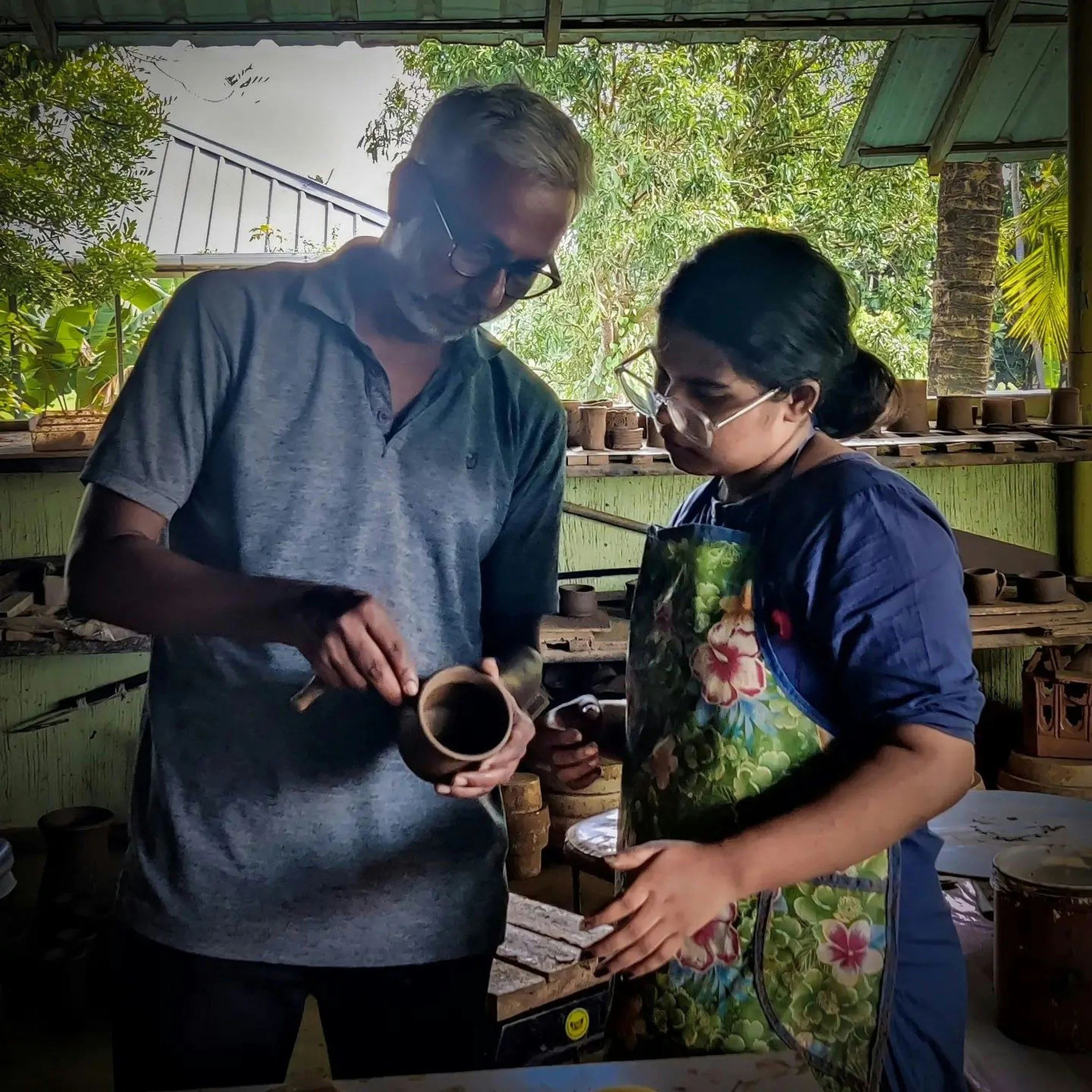
Asking questions…
and staying open to the possibilities helps us deepen our creative work.
Two kinds of thinking, and why we need both
In the brain science world, there's a useful distinction here. Convergent thinking is when we narrow in on the single "correct" solution — it's the A-student mode, the right-answer reflex. We do need this mode to get us over the finish line, make that decision, wrap it up. But it works best when we start with a bit of divergent thinking. Divergent thinking is the opposite: it's open, exploratory, the kind of thinking where one idea sparks five more and you're not yet worried about which one is best.
Both have their place. But creativity leans hard on the divergent side, and divergent thinking thrives on input. It needs fuel — new colors, new approaches, the way someone else solved a problem you didn't even know you had. When we put our heads down and try to do everything "right" all by ourselves, we cut off the very thing that feeds our best ideas: the human connection available all around us.
What isolation actually cost me
I learned this the slow way. After college, I tried to keep my pottery skills up. I signed up for open studio time at a local community college to throw on the wheel, which was a great start. But I was rusty, and I was self-conscious about it. I didn't know anyone else in that studio, so I kept to myself, head down, quietly working.
In that entire three months, I made only a couple of small pieces. And I couldn't tell you a single person's name from that studio. There were no memorable lessons or breakthroughs.
Now contrast that with the GoggleWorks community studio. I was slow to warm up there too — that part of me doesn't just disappear — but eventually I made myself start talking to people. I asked questions. I stopped being so secretive about my own work, stopped guarding it like it had to be perfect before anyone saw it. And the difference was night and day. I learned so much faster. I got better so much quicker. The work itself improved because I finally let other people in, and let go of having to do it "right," on my own.
The collective wisdom in the room
Here's what I keep coming back to. We all learn through experience, and other people have had experiences that we simply haven't. They've made the mistakes we're about to make. They've found the workaround, the better clay body, the trick for centering, the way of seeing that never would have occurred to us on our own.
So when we bring that collective wisdom together — and it can start with something as small as asking one question, beginning one conversation — we don't just learn more. We build a network of colleagues and friends. We turn a roomful of strangers all quietly working alone into something that actually resembles a creative community.
That, to me, is the part worth holding onto. The goal was never really to be the best person in the room. The goal is to be in the room at all, with the door of your practice propped open — because the connection itself turns out to be the thing that makes the art, and the artist, grow.
And if you're an introvert, like me — I know this can feel like a tall order. But connection doesn't have to mean working the room. It can be one quiet question, one person, one conversation at a time. We get to do this in a way that feels like us.
With Enthusiasm for Life + Art,
Heidi
Your turn:
Quick Win: This week, ask one fellow maker a single genuine question about their work. How'd you get that glaze? Where'd that idea come from? Notice how it feels to start the conversation — and what you walk away knowing that you didn't before.
Solid Solution: Pick up Steal Like an Artist by Austin Kleon. It's a quick, encouraging read about how none of us create in a vacuum, and how learning openly from others isn't cheating — it's exactly how good work gets made.
Treat Yourself: Sign up for a group class at GoggleWorks (or an art center near you). Don't just go for the instruction — go for the table of people beside you. The skills are great, but the connections you make there might be what keeps you coming back.