The Power of Getting One Percent Better
We spend much of our lives in a sort of production mode. We move from task to task, making the things, doing the things, and then somewhere in all that churning we stop noticing the mechanics underneath it all. We're too busy keeping the wheels turning to ask whether the wheels could turn a little better.
But every so often, there's real value in doing the opposite of producing. It's amazing what can happen when you pause, pick one small part of your process, and hold it up to the light. Then, when you've inspected it a little closer, you can get granular about how it could improve. It's not natural at first. It feels counterintuitive — like you're slowing down when you should be moving — but it's often where the biggest jumps come from. Let me tell you about a cycling team, the bottoms of my mugs, and my basement steps. And then it'll be your turn.
When you're losing, stop pedaling
In 2003, British Cycling hired a new performance director named Dave Brailsford, and he inherited a famously bad team: They'd earned just a single Olympic gold since 1908, and in over a hundred years, not one Tour de France win. It was so bleak that a top European bike manufacturer reportedly refused to sell them bikes, worried it would look bad to be associated with the team.
But Brailsford had a very different philosophy. He called it the "aggregation of marginal gains", the idea that if you broke down everything that goes into riding a bike and improved each piece by just one percent, those tiny gains would stack into something significant. And that's the part I love most. Before they could improve anything, they had to get off the bikes and break the whole sport down into its smallest parts. Seat design. Tire grip. Which pillow helped riders sleep best. How to wash hands to avoid getting sick before a race. Each change was small, and sounded fairly mundane. But those little things compounded, and within a few years the team was dominating the Olympics and winning the Tour de France! A huge turnaround it a relatively short time. James Clear, who tells this story in his book Atomic Habits, lays out the math that makes it click: get just one percent better every day, and over a single year you end up about thirty-seven times better than where you started. The breakthrough began with a pause, and a magnifying glass.
Zoom in to find the small friction points —
Piling up those little changes will add up faster than you think!
In the studio: the bottoms of my mugs
For years, I never thought about the bottoms of my pieces. I was busy obsessing over glaze colors, the size and shape of a form, finding new ways to decorate a surface — all the exciting stuff. Meanwhile the bottoms were just slightly rough, and it never crossed my mind to care.
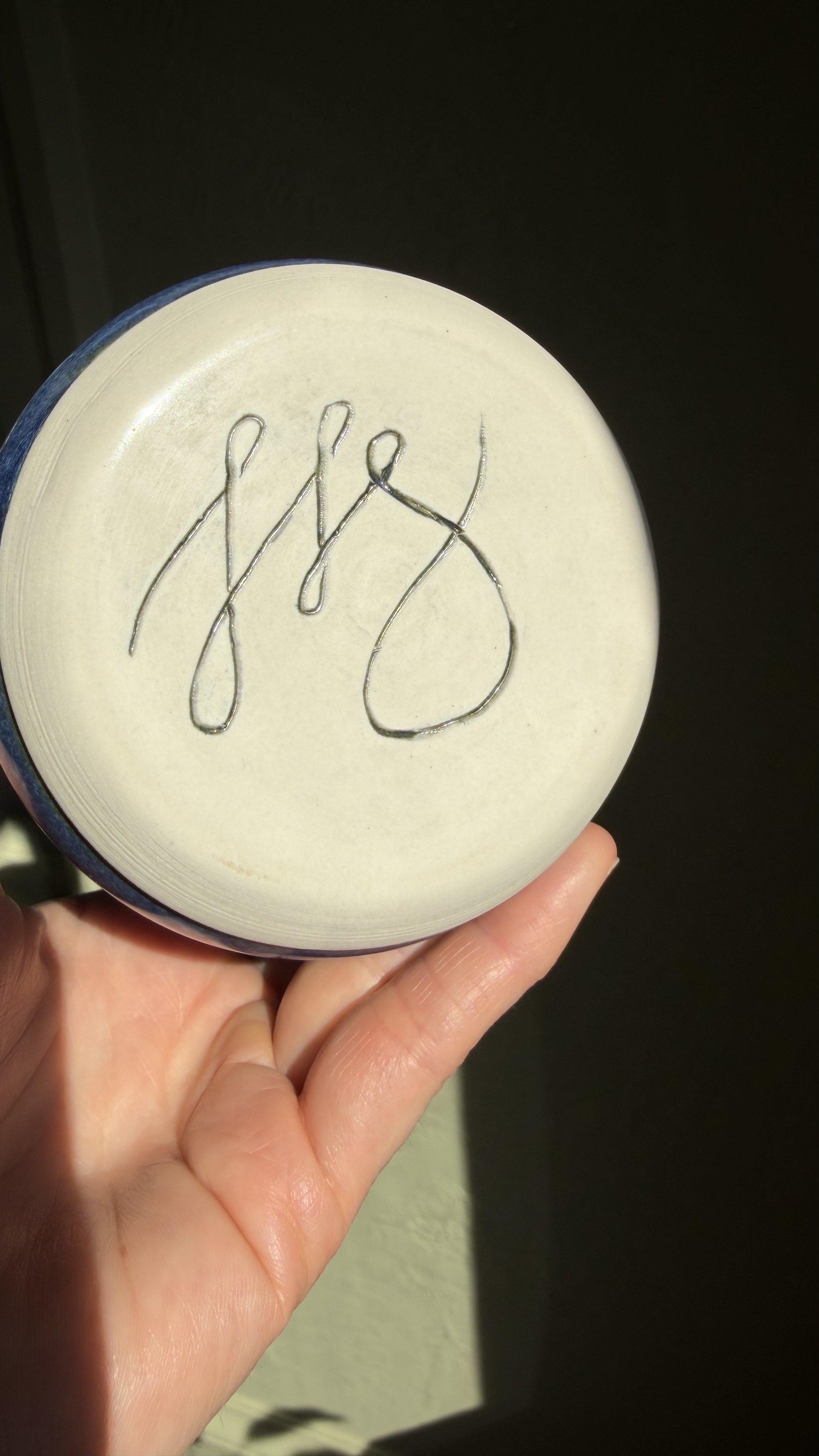
Then I saw someone sanding their bottoms, starting at 60 grit and working all the way up to 7000-grit polishing pads. I tried it, and it genuinely leveled up the work — suddenly the bottoms felt smooth and because it was porcelain, were actually shiny. But this next crucial part is one we don't always remember to do: I had to customize it for me, for my own work. Because the bottoms looked good, but not great. There were still little pits and divots here and there. And when I traced it back, the problem was partly in the way I was trimming the foot. So I changed that step entirely — I eliminated the foot and started shaping a smooth, flat bottom that cut in delicately, curving cleanly from the sides. Now when I sand, the whole bottom is evenly shiny, and you get that satisfying smooth feel when you pick up the cup. That's the rhythm I keep coming back to: dive into one detail, then zoom back out and notice what it did to the whole experience.
Out of the studio: my basement steps
This works far beyond the art itself. The steps down into my basement studio constantly fill with leaves and debris from the trees. The previous owner used to shop-vac them, so I tried that — and quickly discovered that hauling that thing around and reaching it up the rough, mossy steps was a genuine pain.
I really wanted that entryway to feel pleasant to walk through, so I sat back for a minute and asked: how could I get a clean entryway without all that labor and time? The answer turned out to be a $10 stiff-bristled outdoor brush from Home Depot. Now after my morning garden check — every day in a perfect world, at least once a week in reality — I brush the junk straight down to the bottom of the steps, sweep it into a yard-waste bag, and the steps look fresh and welcoming. Ten dollars and a moment of thinking instead of years of dragging a vacuum up the stairs just because it worked for someone else.
How to actually do this
There's a reason this works, and it goes beyond the math. When you stop producing and zoom in on one small piece, you pull your brain out of autopilot and into deliberate, focused attention — and that effortful, narrowed focus is exactly the state in which the brain forms new pathways and genuinely improves. Get that one step down until it feels like second nature, and your attention is freed up for the next small step, and the next. That's the quiet magic of it: each tiny improvement builds on the one before, and the benefits compound far past what any single change could do alone.
The key is to slow down and think about the process you want to improve, and just as importantly, how you want it to improve. Do you want your mugs smoother and more professional? Or more exciting and uniquely shaped? Are you hunting for little efficiencies at home? Do you want a fresh way to frame your work but never seem to have time to dream one up?
Try giving yourself a rethinking week. Set your usual routine aside — keep the bare minimum going so life doesn't fall apart — but let yourself off the hook on perfection and use the breathing room to brainstorm and deep-dive into one single aspect of something you want to improve. A little intention, a little research, some trial and error. That's usually all it takes.
What surprises me every time is how much of what felt out of reach was really just waiting for a pause. And faster than you'd expect, the change stops feeling like an experiment and becomes your new normal — and you won't believe it took you this long to make such a small change. I know I’m excited for my upcoming rethinking week!
With Enthusiasm for Life + Art,
Heidi
Quick Win: Pick one tiny, nagging friction point this week — in your studio or your daily routine — and spend ten minutes just thinking about how it could work better. Don't fix it yet. Just look closely.
Solid Solution: Try a rethinking week. Give yourself permission to step back from output and zoom in on one part of your process, customizing the improvement for your own work and your own life.
Treat Yourself: Pick up Atomic Habits by James Clear, where the cycling story comes from — it's an honest, easy-read look at how small changes compound.