The Power of Reflection: Why We Can’t Afford To Rush Past It
Creativity is a lot of things. Over the years of thinking and writing on the topic, I’ve settled on 8 pillars of the creative process: 1. Set the Stage 2. Fill the Well 3. Build Your Skills 4. Create 5. Connect 6. Understand 7. Reflect and 8. Behind the Scenes.
Today, it's fitting to be writing about reflection, seeing as how I'm halfway around the world at the Rotary International Conference in Taipei, with plenty of travel time to think about where I’ve been, and where I'd like to go next. Join me in this real-time reflection — and see how even the brief pause of one morning can be the difference in living a meaningful life on your own terms, and reaching creative goals you might have rushed past if you hadn’t stopped to think.
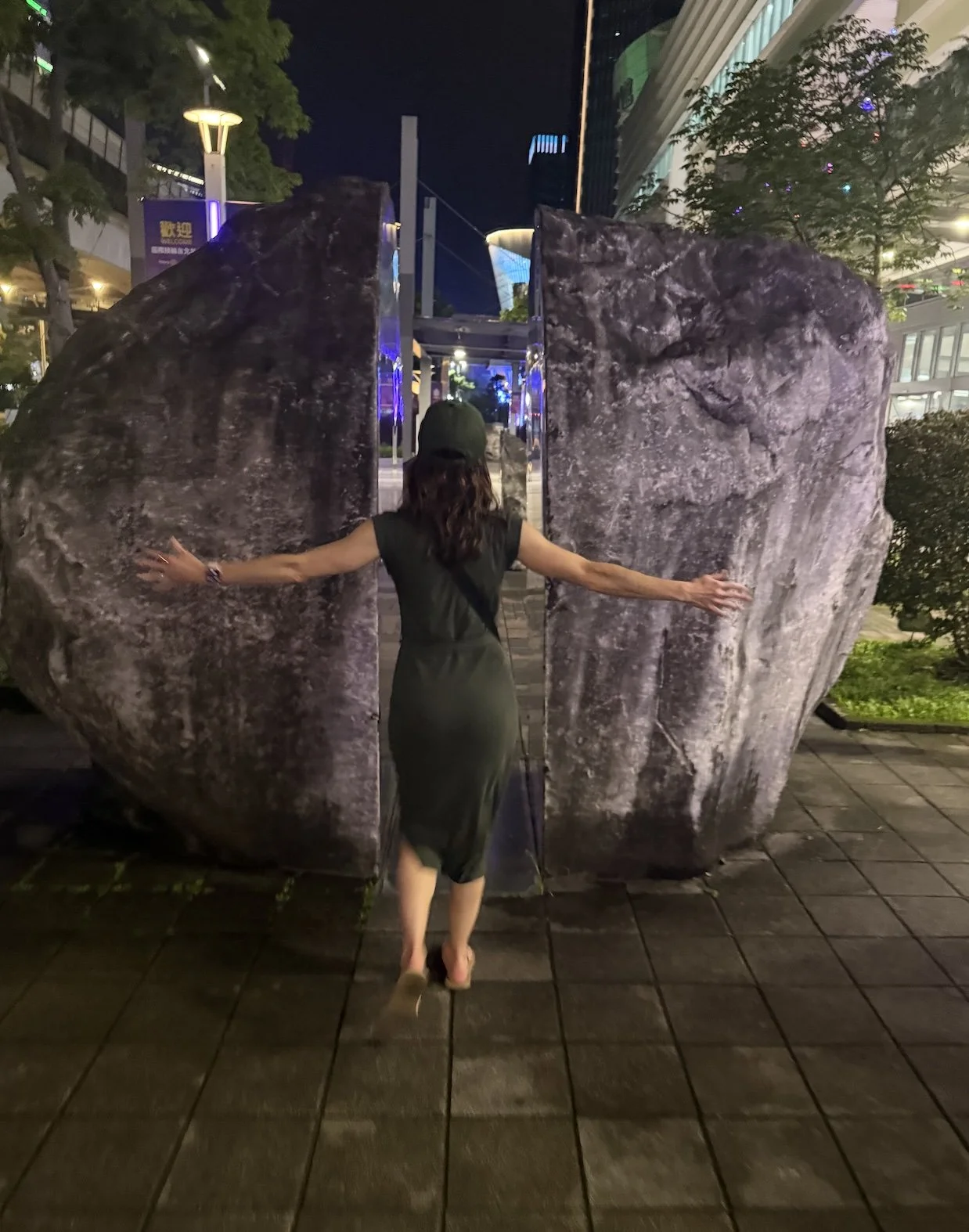
The Beat of Civilization: the Space between Thoughts — Lin Shuen-Long & Chen Chu-Yin, 2007
The Beat of Civilization: the Space between Thoughts — Lin Shuen-Long & Chen Chu-Yin, 2007Two steel cubes face each other across a distance, linked by twelve sculpted stones with a void running between them: the space between one thought and the next, where all the possibilities live. You're meant to walk into that gap and reflect. I couldn't have asked for a better spot to stand and think about where my art has been and where it's headed.
Six years ago, like most of the world, I was in the midst of a forced six-week hiatus from work. Not just any hiatus, but a break where there were no sports, no school activities, no meetings — nothing but family time and the inside of my own mind.
I can still feel the sun streaming in the kitchen window and the warmth of the soapy dishwater, and I can still hear my inner voice clearly saying, "What am I doing with my life? If not now, when?" At 40 years old, I was fighting an uphill battle trying to relax into who I really am, what I am here to do — and I was trying to do it in a world that was battling with my nervous system every day. I was trying to be "me" — creative, quiet, imaginative, focused me — in the chaotic, rushed space of the healthcare world.
I'm still oddly grateful for those uncertain times, and the forced solitude that led to the most crystal-clear internal direction I've ever had in my life. Stop resisting, the voice said. I didn't know how exactly, but I knew it was time to go towards my artistic dreams. The actual goal or dream was cloudy. I'd been shoving it back down for a very long time. There's a lot to process there, but today what I want to focus on is what I did not have. I did not have a clear picture of who I was as an artist. I did NOT have a vision of exactly what I wanted to achieve artistically. There was not a clear path ahead. There was no reassurance that I could do it, no evidence. My husband's income to support us gave me the option, technically — but my entire identity was at risk. It was like stepping off a cliff in many ways. Yet — I knew in my body that I had to. HAD TO. Wait, had to what?!
Go towards. For the very first time in my life, I did not have a plan. There was no tried-and-true path to becoming an artist; art school was out of the question because I was 40 with 2 kids, four degrees, two professional licenses, one fellowship certification, and was proposing using none of that going forward with no promise of future income.
But there WAS the strong call to go forward, towards the only thing I'd ever really wanted to do. Make things and be happy. To me, they were the same thing. So, from there, where did my art begin, and where is it now, six years later? And how can I intentionally shape what happens next?
Back then, I began with realistic 4-inch paintings of flowers — small, because I had no studio, and concrete, because I wanted to prove I could do it: see the color, mix the color, paint the color. And it worked. But the moment I knew I could do it consistently, my enthusiasm drained right out of the tedium.
So I went looking for the opposite. Louise Fletcher's "Find Your Joy" unlocked something — almost nothing I made in that course was any good, which turned out to be the entire point: to make art that feels good without judging the outcome. A portrait workshop with Tamara LaPorte stuck, and I started making semi-abstract pieces, some with florals or self-portraits worked in, that began to feel really good, honest and me. And the whole time, in the background, I was throwing pottery at the community studio.
Let me pause here, because there's a pattern underneath all this caution that I can only see now, looking back. If something is precious to me, I tend to hide it. I delay gratification to a fault — so much so that the enjoyment often never comes at all. I don't want to ruin it, so I never use it. Like the white couch at your grandmother's house with the plastic still on it. Or the fine china that never leaves the cupboard. That probably needs further unpacking in therapy, but for now let's see if I can keep pushing into it as I make my art.
So this is how I slowly and carefully began to throw pottery again. Not in front of anyone, not asking questions, and not making mistakes. Not risking, not pushing. Very slowly and cautiously — I wanted to be good in such a fundamental way: But what if I try, and I'm NOT that good? So I kept it pretty safe. I made successful but safe (= boring) work. I dabbled in painting, clay, and didn't submit to many shows or take too many risks.
What I did right, though, was I kept showing up. And pinched myself every day that I worked in this inspiring art center full of creativity, color, imperfection, and energy. And it began to rub off on me. People began to respond to what I was making. I gradually learned new techniques, tried things, abandoned some and adopted the ones that felt like me. Strengthened my intuition. Gave myself grace. Not every day. But more and more. These first six years have been slow going. But I'm so happy that I'm on my path. Not a path that’s easy to summarize on a conference name tag, or sounds good at parties. Not a path defined by degrees or credentials. Something much more certain than any of that.
I'm living in a way now where every new sight triggers a flood of inspiration. Every person I meet is a source of wisdom and life experience that, if I'm curious, can make me a better person. Our common drive to develop and express our creativity is something that connects us. Art has been a way to feel and see what past humans have loved, struggled with, found joy in. It is a common thread through time and space, and to me it's everything. It's why I am here.
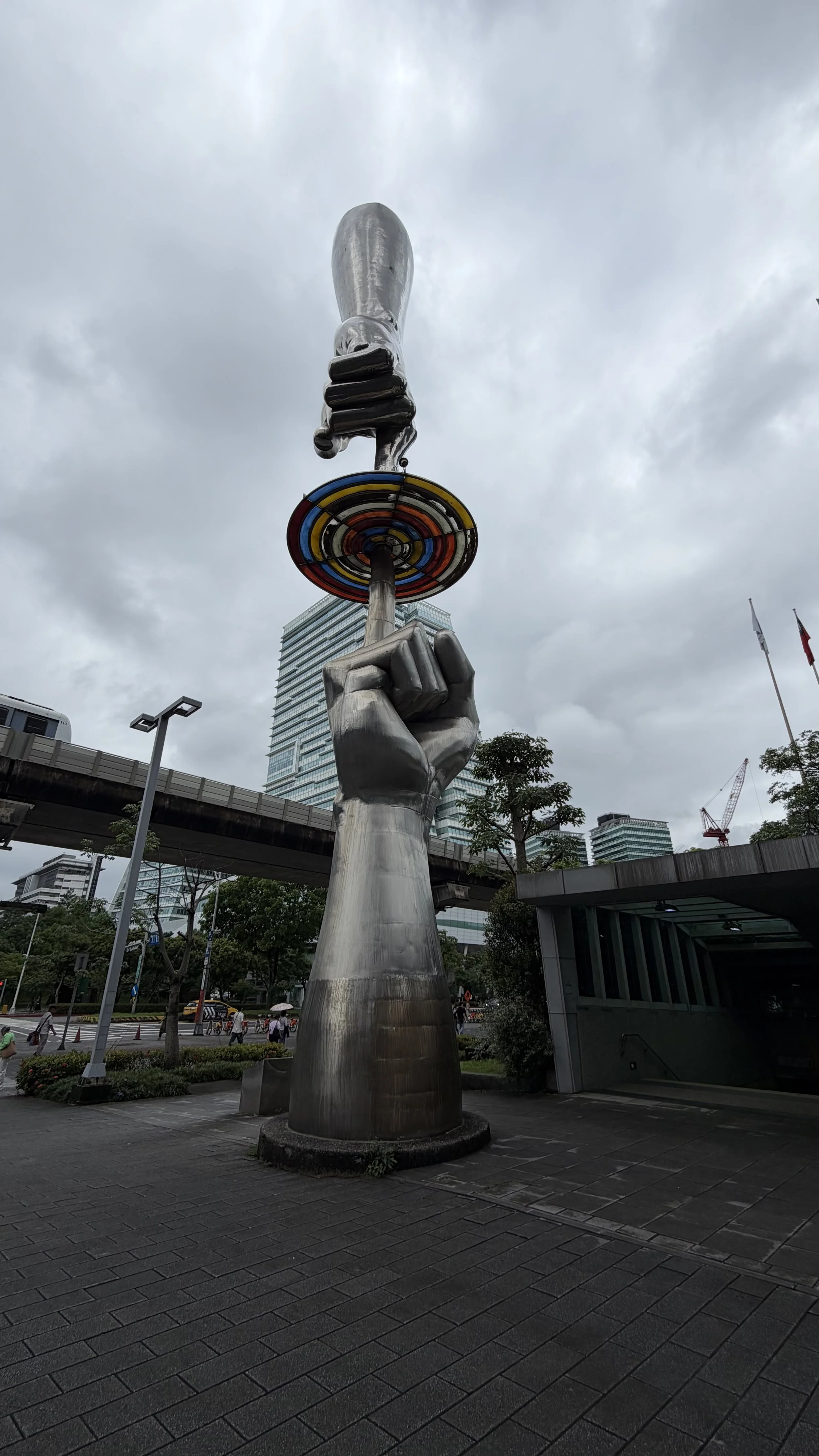
Boundary between Heaven and Man (天人境界)
by Shuen-Long Lin, 2008
The two giant hands outside Taipei's Nangang Exhibition Center. One points to the earth, one to the sky, meeting at the fingertips where nine rings of colored kiln-fired glass glow between them. The artist meant it as the eternal link between humanity and the heavens, the glass circles standing for infinity and limitless expansion. A fitting thing to stand under while reflecting on a creative path.
So, as I reflect on all of this here in Taipei, where the language is so very foreign to me, I see beautiful colors, foods, and sculptures. I see the smiles and the struggles that connect us.
It's one more confirmation that I'm ready to continue on my creative path, and time is precious. I'm 47 now. Plenty of time, and yet each day matters so acutely to me when I stop to really process it. You have my word that the next six years, no matter where they take me, will be more free, more curious, more prolific, more experimental, and more connected to this common creativity in all of us. I will make more mistakes, not less. My art will be so much better for it.
And so will I.
With Enthusiasm for Life + Art,
Heidi
Quick Win: Before you reach for the next thing on your list today, take the brief pause. Five quiet minutes, no phone — just one honest question: what am I doing, and is it taking me where I want to go? You don't need a conference in Taipei. A kitchen sink is just fine.
Solid Solution: Set aside an hour this week to look back over the last few months of your creative life — not to judge it, but to notice the patterns. Is there anything you keep avoiding? What felt like you? My free Artist Quarterly Review Workbook walks you through exactly this kind of reflection, step by step, if you prefer structure.
Treat Yourself: Block out a half-day with no agenda and let yourself be a tourist in your own creativity — wander a museum, sit with a sketchbook somewhere new, or pick up a new book of inspiration or poetry and let someone else's reflection prompt your own.