How to Use Other People's Reactions to Find Your Creative Signal
What a chance encounter in my studio taught me about tuning in, listening up, and staying true to your work.
Yesterday, a young couple came into my studio. Wide-eyed, fully taking in all of the art. She told me they lived nearby and just decided to come and look around. He asked questions about a few of my pieces. I shared a bit about the work and then asked if they also made art. "I want to!" she said. They sheepishly looked at each other in a silent conversation I wasn't invited into. They kept coming back to my large triptych — one of the first self-reflective pieces I made when I first got my studio. They were so genuinely interested, I found myself telling them the whole story, bit by bit, opening up more as they engaged with me. They commented on common threads between that and some of the other paintings in the studio — very insightful observations, really. And their honesty brought mine out. I even said to them, "Wow. That makes me feel so good. You actually felt the connections and messages I had in my mind — and you almost had better words for it than I do." "Yeah man," he said, "that's real." As they walked out they were still talking to each other: "I love the self portrait ones, that was awesome." And tears sprung to my eyes. Damn. That's SO real. That's what art should do — transfer a feeling from me to you, through this beautiful thing. It came through. I'll be chasing that moment for a long time.
And then — how DO we chase that moment? It's not a linear thread, for sure. But in talking to that couple, I was gifted a few clues about how to use connection and sharing your work as a map forward.
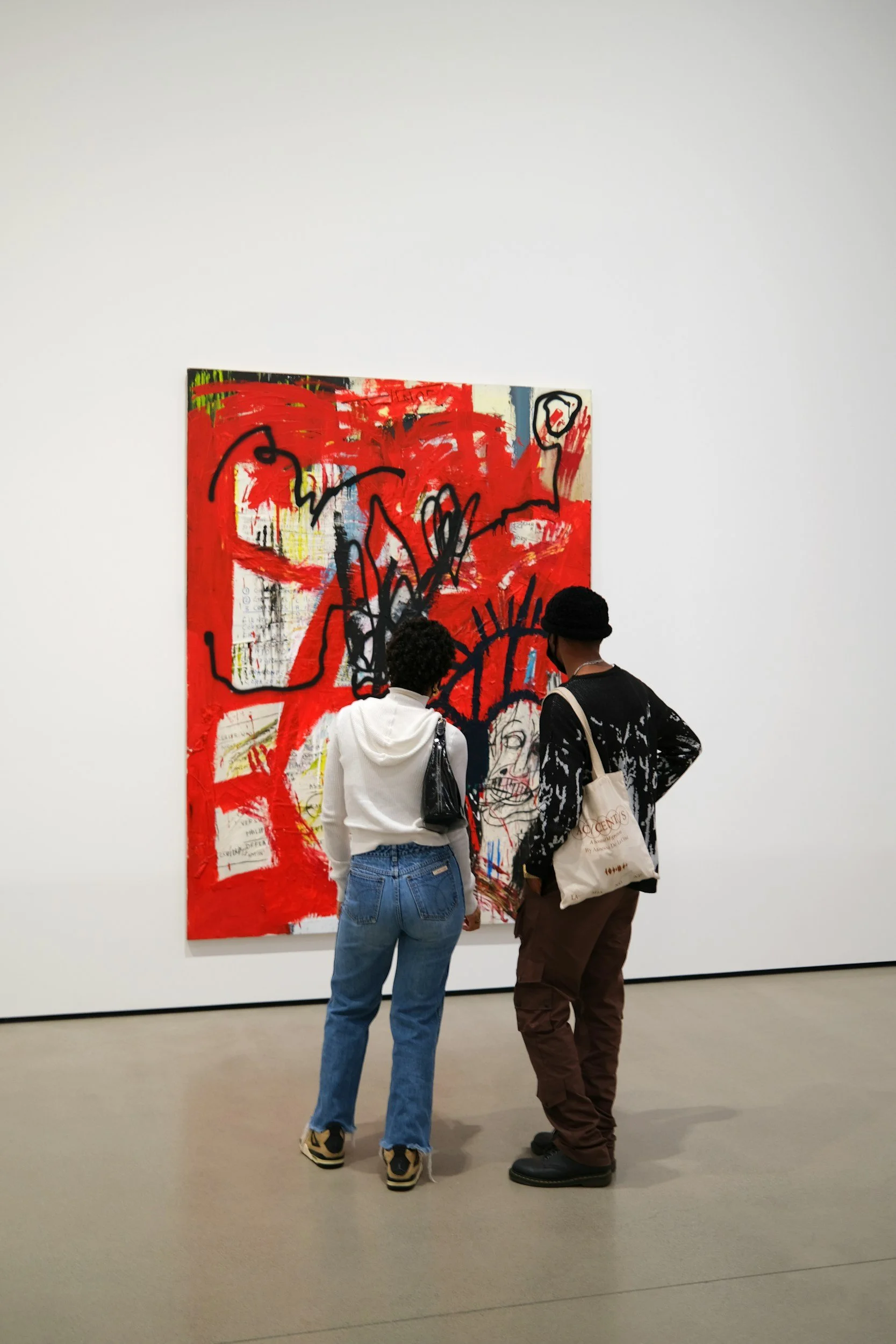
What do they see? Feel?
Giving your art an audience helps you understand yourself and your work.
Your Work Is Not For Everyone (And That's a Good Thing)
The first clue to follow: Your work is not for everyone. YOU are not for everyone. Now, I've heard that before. I've read a lot of creativity books, and many of them remind us, as artists, that we can't try to please everyone. I cognitively agree. Yet we often still WANT to. Try to, on some level. These twenty-somethings reminded me of that. Because I've talked about that piece many times to studio visitors, friends and family over the five or six years since I made it. And no one responded as clearly and strongly as these two. I'm so okay with that — in fact, it made it even more meaningful that a stranger who knows nothing about me could walk in and feel emotions and connections between shapes, colors, magazine clippings and found objects. The same feelings I had when creating the piece all that time ago. I think that's why the tears sprung to my eyes — they were describing feelings I had forgotten about. Powerful stuff, and worth it all. My work, your work, even just how we are as people moving through this world — it is not for everyone, which is a good thing. Really understanding and agreeing with that is very freeing, and allows us to go further into that center of who we really are.
Listen to the Space Between
As we share our creative work, we start to notice that different people get different things from it. They may connect with the meaning behind it — and this might be the meaning you intended, but it might not. It might be something they've experienced that it reminds them of. They might have words for it, and they might not. Maybe the colors take them into a certain mindset, or the subject matter is important to them and they are drawn to your piece for that reason. All of it valid, and all of it out of your control. Once you've made the work and put it out there, that's the job. But if we can drop our concerns about how it is received and instead really LISTEN to others' responses, we can learn what is happening in that space in between the work and its audience. This is not just true for paintings, but pieces of writing, sculpture, even a ceramic mug. I passed a mug around at my wheel-throwing class the other day. It had a twisted handle, and half the room loved how it fit in their hand, and the others were like, no, that's not quite comfortable for how I hold my mugs. Exactly. There’s nothing “wrong” with it, it’s just not for them. When it does fit, you know. You sense it, you relax, and it feels right, like it’s yours.
In my paintings or pottery, I can listen to the responses of others — and here is the key — not change my whole way of making just to please a stranger, but instead hear the response and see how it makes ME feel. My response to their response. And that's what happened in my studio that day. I want to feel THAT. I want to know somebody sees what I was trying to get across. Someone feels it at their core. I want to know that there are people out there sensing the frequency I'm emitting. It strengthens my signal and keeps me true to myself.
Tune Your Signal
Here's a way to think about this that really clicked for me. If you're not already listening to Andy J. Pizza's Creative Pep Talk podcast, add it to your list — he has this way of making you feel like someone actually gets the weird, tender, slightly chaotic experience of being a creative person. One thing he talks about is getting specific about the kind of emotional response you're actually going for. Not just a vague hope that people will "like" your work, but really tuning in. He uses comedians as an example: comedians aren't just going for a laugh. They may be going for a surprise laugh (did not see THAT coming!), a familiar laugh (it's funny cause it's true), or a dark laugh (ohh, that's so wrong but so funny). The more specific they get about which kind of laugh they want, the better they get at landing it. We can do the same thing. What kind of response are you really going for? A quiet, reflective pause? A gut-punch of recognition? That warm, I-want-to-hold-this feeling? Hone in on it. Feel it when it happens, notice it, strengthen your radar for it.
Now go make something, and share it. Don't stress if people don't quite get it — just listen to them, and keep sharing. It will make you a better artist, but it will also build your confidence and peace in who you are.
With Enthusiasm for Life + Art,
Heidi
Quick Win: Share one piece of your work this week — a photo, a post, a text to a friend. Put up your antennae. Notice what comes back.
Solid Solution: Ready to put your work in front of more eyes? Look up a local show, open studio, or community display opportunity and submit something. The act of putting it out there IS the practice.
Treat Yourself: Want to go deeper on finding and strengthening your creative voice? Coaching is coming soon — reply and let me know you're interested.