Here's a question I bet you've never asked yourself while sitting at the pottery wheel or staring down a blank canvas: What problem am I solving?
I realize it sounds like something from a business strategy meeting, not a studio practice. But let’s look a little deeper at thinking about creative work as solving a problem. Once you start thinking about art through this lens, everything shifts.
Creativity Is Problem-Solving (Even When It Doesn't Look Like It)
When people tell me they're "not creative," one of my favorite moves is to ask: What kinds of problems are you good at solving? The conversation gets interesting fast. Creativity can look less like a painting, and more like an engineer who figured out how to make a beautiful and strong joint in his little woodshop in the basement. Or the parents who invented a whole game to make their kid eat vegetables!
Creativity isn't just making things. It's making connections — between a problem and a solution — in a way no one else has quite done before.
Which means your art, at its best, is doing exactly that.
I recently heard an interesting story about a woman who started a prominent gourmet dessert business. It now operates in over 60 countries, with annual revenues approaching the hundreds of millions. But that's not what the story was about. An employee of hers told me – with a twinkle in his eye – how she started. She filled large glass display jars with cookies she baked herself. Then, she asked local businesses to put the jar on their front counter, and she would refill it when it ran low.
No expensive packaging. No marketing budget. Just cookies in a beautiful jar.
Such an elegant solution! She wasn't just solving a business problem. She was solving the customer's problem — that little afternoon slump when you just want a treat while you're out running errands. Win-win, beautifully simple, surprisingly effective.
Your art can do the same thing.
So What Problems Can Art Actually Solve?
More than you might think. Art can make you feel something you needed to feel. It can remind you of something you'd almost forgotten. It can validate your emotions, your values, your point of view. It can answer a question — or ask one you didn't even know needed asking. It can transfer energy across a room. It can inspire someone to pick up a brush for the first time, or finally take action on something they've been sitting on for years. Even help you feel like you’re not alone. That's pretty powerful stuff.
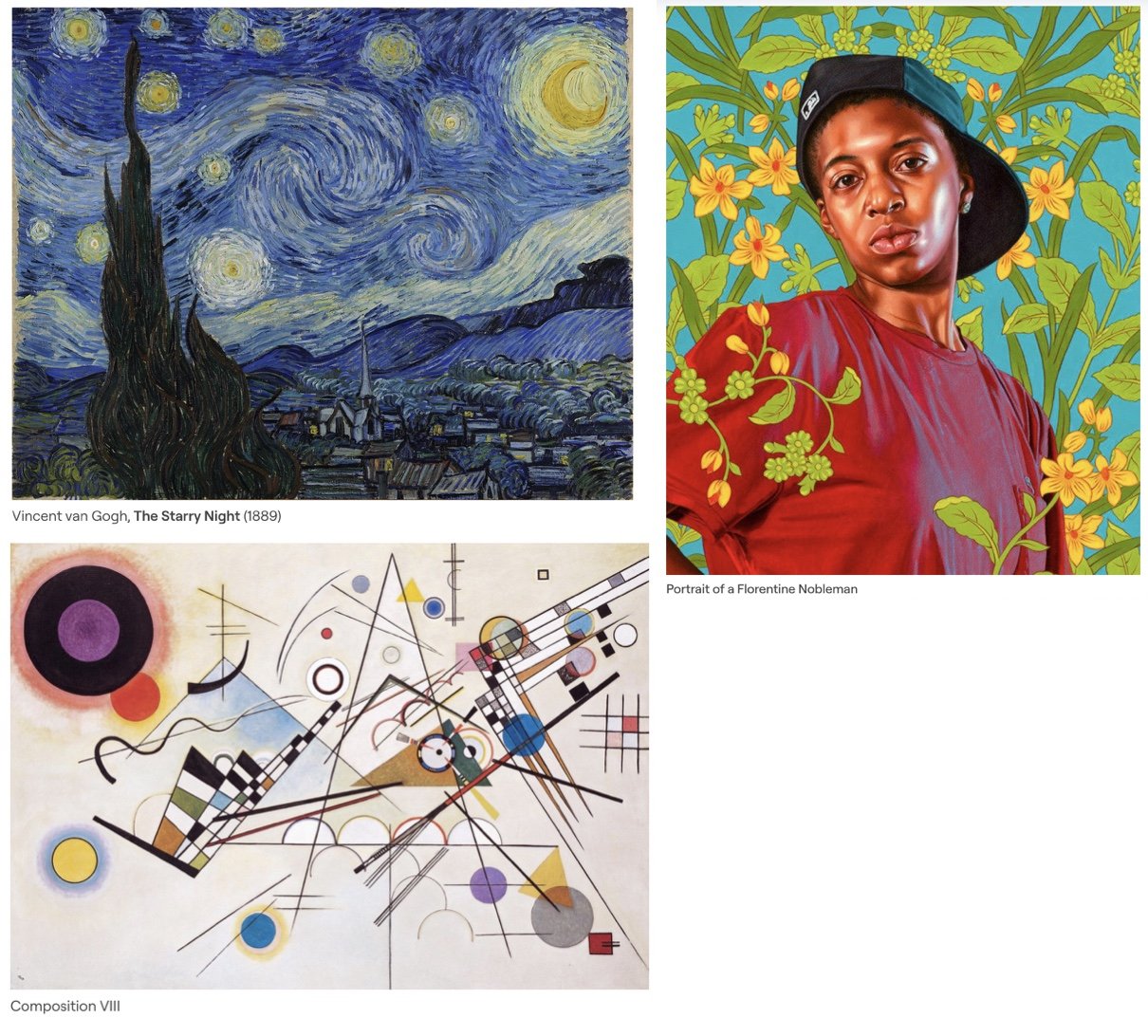
Vincent van Gogh, Starry Night (1889), Wassily Kandinsky, Composition VII (1923 ), Kehinde Wiley, Portrait of a Florentine Nobleman (2008)
Three Pieces That Solve Real Problems
Starry Night (Van Gogh, 1889) solved the problem of how to express an emotional interior life that words can't quite reach. People return to it again and again because it names something that feels almost unnameable.
Composition VIII (Kandinsky, 1923) solved the problem of whether pure emotion could be expressed without depicting anything from the physical world at all — no figures, no landscapes, nothing recognizable. Just shape, color, and line doing all the work. It helped answer the question: How can we depict music and energy visually?
Kehinde Wiley's portraits solve the problem of whose image gets to be monumental, whose story gets to be told in the visual language of history and grandeur. Swap the subject, shift the power. Revolutionary.
These artists may not have sat down to work and said, "I shall now solve a problem." But they were paying attention to what was missing — and they filled that space.
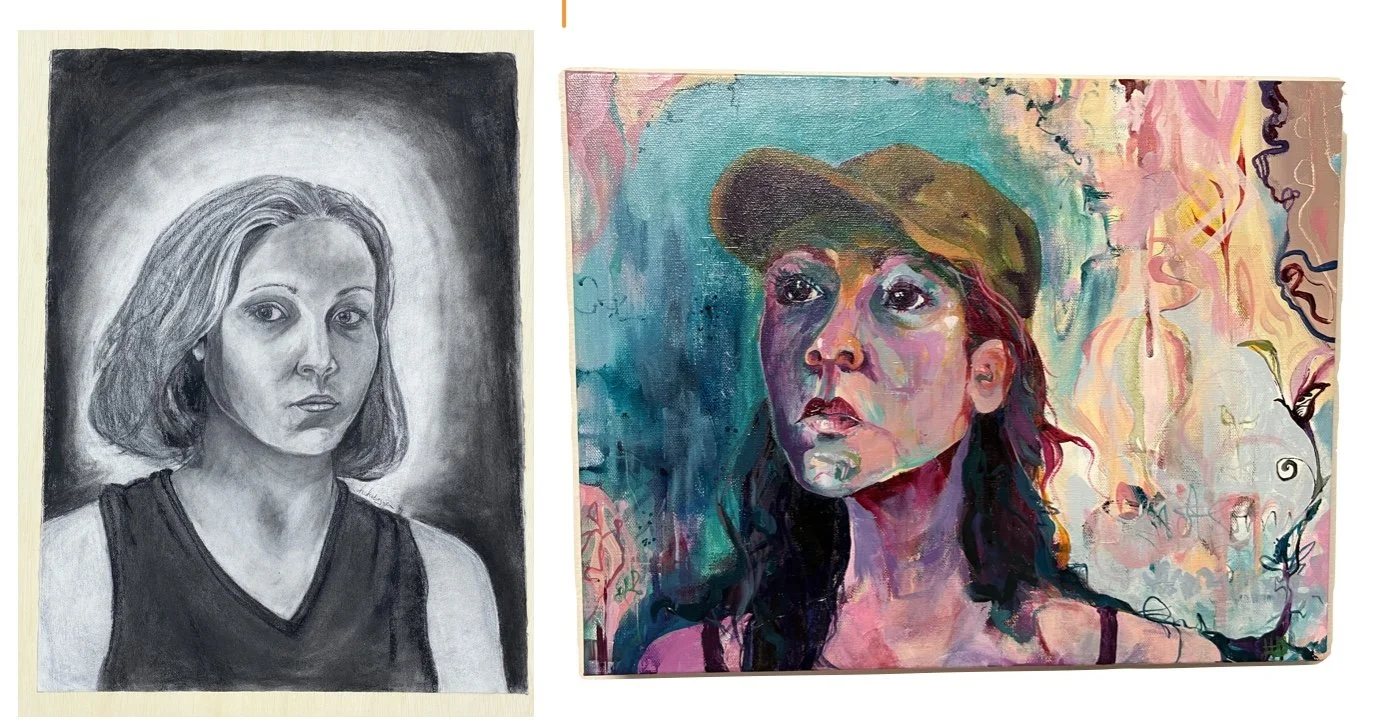
Heidi Sensenig, Self Portrait (1998), and Heidi Sensenig, Self-Study (2024)
The Difference Between Art That Lands and Art That Doesn't
I have a charcoal self-portrait from college that I think about sometimes. It followed the assignment: high contrast, realistic scale, a reasonable likeness. It was... fine. And also completely empty. The only problem it solved was teaching me to shade better. For any viewer? Nothing. You can feel the tension in it — me white-knuckling my way to "getting it right."
Contrast that with a self-portrait I painted more recently. My expression shows determination and hope. The background is abstract and colorful, a little dreamy. Almost everyone who comes into my studio comments on it.
When I think about why, I think it's because that painting solves something for the viewer. It says: It's okay to put yourself out there with your own hopes and colors. You don't have to apologize for taking up space. It's an answer to the quiet, ongoing question of who we are and how we get there.
When I painted it, I wasn't focused on technique. I was focused on feeling. And that came through.
Your Turn: What Do You Want to Solve?
Before your next creative session, take a few minutes — even just a long walk with your voice memo app open — and let yourself wander around these questions:
What energy do you want someone to feel when they experience your work?
What do you want to affirm, stand up to, or shout from the rooftops?
What did you need to hear as a younger artist or person that you could give to someone now?
What's a problem — even a small one — that you wish the world had better answers for?
You don't have to solve it all. Your art doesn't need to be a manifesto. It can answer just one thread of the question — and that thread gets woven into the larger tapestry of human creative wisdom. Which is really just how all of it works.
We're better together. And the more we each keep offering our best thinking, asking good questions, and making more art — the richer that tapestry gets.
So: what problem could your art solve?
Quick Win: Grab a notebook and free-write for 10 minutes on the questions above before your next creative session. Don't edit. Just notice what comes up.
Solid Solution: If this post got your wheels turning, Austin Kleon's Steal Like an Artist is a fun, fast read that will push you even further — specifically around finding your influences, owning your voice, and making work that actually means something. 10/10 recommend.
Treat Yourself: Ready to make more intentional art in real time? Come spend some time at GoggleWorks if you're local — or find a small group class or private session at a nearby art center if not. There's something about making art with guidance and intention that shifts everything. [Link to Explore Classes]
With Enthusiasm for Life + Art,